Italia
Florencia
Is the birthplace of the Renaissance
Sobre Florencia
Cradle of the Renaissance, romantic, enchanting and utterly irresistible, Florence (Firenze) is a place to feast on world-class art and gourmet Tuscan cuisine.
Lugares destacados
1
Museo di Sam Marco
At the heart of Florence's university area sits Chiesa di San Marco and an adjoining 15th-century Dominican monastery where both gifted painter Fra' Angelico (c 1395–1455) and the sharp-tongued Savonarola piously served God. Today the monastery, aka one of Florence's most spiritually uplifting museums, showcases the work of Fra' Angelico. After centuries of being known as 'Il Beato Angelico' (literally 'The Blessed Angelic One') or simply 'Il Beato' (The Blessed), the Renaissance's most blessed religious painter was made a saint by Pope John Paul II in 1984.
2
Museo delle Cappelle Medicee
Nowhere is Medici conceit expressed so explicitly as in the Medici Chapels. Adorned with granite, marble, semiprecious stones and some of Michelangelo's most beautiful sculptures, it is the burial place of 49 dynasty members. Francesco I lies in the dark, imposing Cappella dei Principi (Chapel of Princes) alongside Ferdinando I and II and Cosimo I, II and III. Lorenzo Il Magnifico is buried in the graceful Sagrestia Nuova (New Sacristy), which was Michelangelo's first architectural work.
3
Galleria degli Uffizi
Home to the world's greatest collection of Italian Renaissance art, Florence's premier gallery occupies the vast U-shaped Palazzo degli Uffizi (1560–80), built as government offices. The collection, bequeathed to the city by the Medici family in 1743 on condition that it never leave Florence, contains some of Italy's best-known paintings, including a room full of Botticelli masterpieces.
A combined ticket (valid three days) with Palazzo Pitti, Giardino di Boboli and Museo Archeologico is available for €38/21 (€18/11 November to February).
4
Duomo
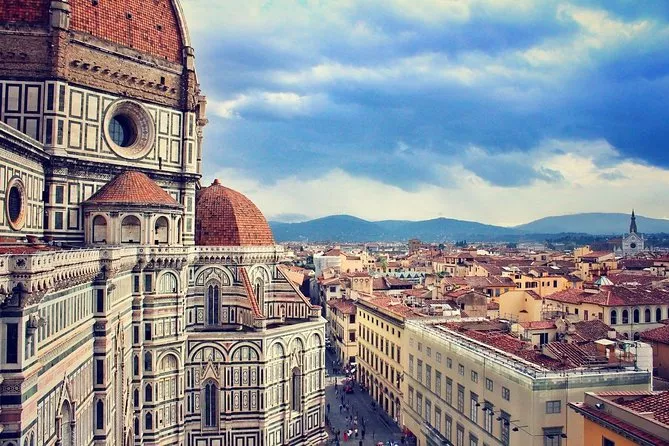
Florence's duomo is the city's most iconic landmark. Capped by Filippo Brunelleschi's red-tiled cupola, it's a staggering construction whose breathtaking pink, white and green marble facade and graceful campanile dominate the Renaissance cityscape. Sienese architect Arnolfo di Cambio began work on it in 1296, but construction took almost 150 years and it wasn't consecrated until 1436. In the echoing interior, look out for frescoes by Vasari and Zuccari and up to 44 stained-glass windows.
Actividades en Florencia
Ver los 20